_edited.png)
Sometimes It Isn't You.
Updated: Aug 3
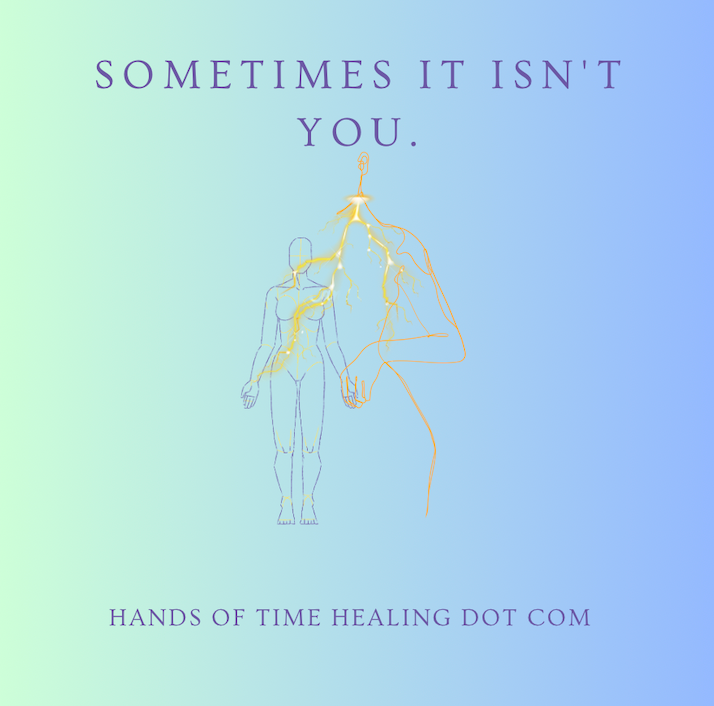
Sometimes it's the System That's Been Living Life with You.
Have you ever stopped and wondered why recovering from stress feels so much harder for some people than it does for others?
Not just getting through a difficult day.
I mean truly recovering and finally landing in a way that you find your way back to yourself.
For some, it seems to happen naturally.
For others, no matter how many books they read, breathing techniques they practice or therapies they try, they still feel as though they're living with one foot on the accelerator and the other on the brake.
Always preparing.
Always scanning.
Always trying to get back to a place they've never quite been able to find.
Over the years I've come to see this a little differently.
I don't believe people are failing at recovery.
I believe many are trying to recover with a system that has itself become compromised and that has possibly suffered multiple breaches.
When I say compromised, I mean a system that has had to work so hard for so long. I'm reminded of an old saying: 'left flying on a wing and a prayer'. We are left without attending to the fact that the very system that should naturally bring us back to balance has been compromised. That is supposed to help us take off, and land has gradually lost some of its ability to restore itself.
I often think of it as our internal guidance and security system.
Not one organ or one nerve, and definitely not just one part of the brain. A real-life living collaboration between your sensory somatic system, your autonomic and motor system, your relationship with yourself and others. Of course we cannot leave out your brain, your heart, your gut and every pathway that quietly works day in and day out, day and night to keep you alive and in balance.
Most of the time we hardly notice it, until of course balance becomes difficult. Maybe that shows up psychologically, and more than likely both. Sometimes the compromise is based in physiology.
I myself live with a very compromised nervous system; some years ago I couldn't understand why every time I stood up I felt dizzy and why I was struggling so much to recover from a very stressful time in life.
"The most common autonomic disorders encountered in clinical practice are postural orthostatic tachycardia syndrome (POTS), neurocardiogenic syncope (NCS), and orthostatic hypotension (OH), which may be undiagnosed or often mislabeled with psychiatric disorders." As published by PUBMED in an article titled: Dysautonomia: a common comorbidity of systemic disease
Even more recently, I had a virus that never quite left me. As a child, I had a severe head injury that affected how I learned and moved in the world. And so the list goes on and on.
Some may have experienced medical traumas. Combine some, all, or any of these with years of chronic stress, and suddenly;
Your heart races without warning.
Your blood pressure fluctuates.
Your body struggles to regulate temperature.
Energy comes and goes without explanation, and the brain fog becomes real.
Your brain and internal systems begin spending so much of their energy trying to maintain balance that very little is left for living.
Other times the compromise comes through repeated breaches.
Not physical breaches as such, but more relational ones that compromise our physiology because of the immense stress they cause. Add betrayal stress, for instance, a sudden shocking life event, a divorce, job loss. Add these into this mix or as a stand-alone, and your system is staying in survival mode until you restore that vital self-trust that truly signals it's all over; you can begin a recovery process.
Why is it that I don't begin with safety, breath work? Because it's counterproductive to force states onto a system that's already overwhelmed.
Also, if your needs were rarely met in childhood or early adulthood, you possibly learned very early that it was safer not to have any needs or need anyone. By forcing safety, you can inadvertently reinforce a prediction that signals being dismissed or that 'you are not deserving of attuned attention'. When you take the time to attune, or if someone else takes that time, it is truly a powerful feeling that helps you feel felt at a level that changes how your nervous system receives new possibilities. Maybe even a more true core belief can enter at an embodied state level and land in a way that completely relaxes your body, mind, and soul.
If your outer home was unpredictable and lacked that essential attunement, you possibly became;
The predictable one.
The responsible one.
The peacemaker.
The Pleaser
The child who stayed ready because the environment around you was always ready to erupt.
The body learns from every one of those experiences and predicts what is going to happen. I call these templates of our future life, but we can change them. In general, people don't choose to change until something you deem very valuable in your current life feels threatened , i.e., your sanity, your marriage, your friends, the job you love and want to keep or evolve in, maybe your children. In general, there is a trigger to heal, and to choose this system as a starting place is foundational.
You know I spend a lot of time talking about relationships and self-trust. Not just relationships with other people but the relationship you have with your body and your brain, your thoughts and your emotions, and with this remarkable system that's been living with all these years. Because whether your system has been compromised through illness, injury, or repeated relational breaches, it is still communicating, and it's essential to learn its language.
The question is...
"Do you know how to listen through the most kind, gentle and embodied form of self-empathy?
This is essential to the focus I place on attunement, and you can learn this as a skill and apply it in ways that can make a real difference in every area of your life.
Attunement isn't about analyzing yourself or searching for what's wrong.
It isn't about over-self-monitoring or becoming hyper-aware of every sensation.
Attunement is learning how to communicate with your internal guidance and security system in a way that helps healing unfold naturally; it helps organize your body and brain rather than leaving them overwhelmed as you try to make progress. That's the one-step-forward, two-steps-back exasperation people feel when they feel it's not them, it's the system.
How does the boy communicate? Sometimes it's in incredibly ordinary ways that we often overlook because they just became normal; for example
"I'm clenching my jaw."
"My breathing has become shallow."
"My shoulders are up around my ears."
"My feet don't feel connected to the ground."
These are all really important messages, and the moment we begin listening with curiosity rather than criticism, something begins to change.
But instead we are taught to look for the bigger issues, when these are the signs and signals that are communicating our deeper needs for reconnection, orientation, and even our need for some form of certainty in this moment. These are all signs and signals that the system is stuck or lost and needs your guidance.
Your body loves when you attune to its needs; it feels when you are with yourself. People often ask me why I place so much emphasis on the many layers to this system, including the sensory system.
It's very simply because the sensory system is always listening; it has direct access to the survival brain, and you can use it to attune to your deeper needs, orient, ground, and center.
With experience, it can communicate all the way into the deeper parts of the brain, to help both the survival and the cognitive brain work better together, rather than battle together.
When the body knows
"This is where we are."
"This is what's happening."
"This is what belongs to now."
When that message becomes clearer, the brainstem doesn't have to organize quite so much survival. The thinking brain doesn't have to work so hard to explain everything and wade through muddy cortisol. Over time, the emotional brain has more room to make sense of what you're feeling instead of fearing your feelings, shutting down, or overreacting to them.
Discernment begins to return. Quickly for some and more gradually for others.
As a practitioner, I'd rather help you build a system that knows how to receive life again.
Not just survive it.
That, to me, is where healing starts and where the true feeling of healing begins to arrive.
If you need support with this foundational yet transformational work.
Message me via the link below, and I’ll guide you from here.
RISE to WISE | 1:1 Healing Work Empowered by CoreNeuroCare©
Real care happens inside the multi-layered nervous system integration work where survival states are no longer overridden but accompanied.
No parts of this blog can be used or copied without permission from the owner and author.
Comments